▍ Data Bank · NASA Fact Sheets
The real science behind every mission
Each ASTRA destination is a real place NASA studies. Here are the numbers your spacecraft has to survive.
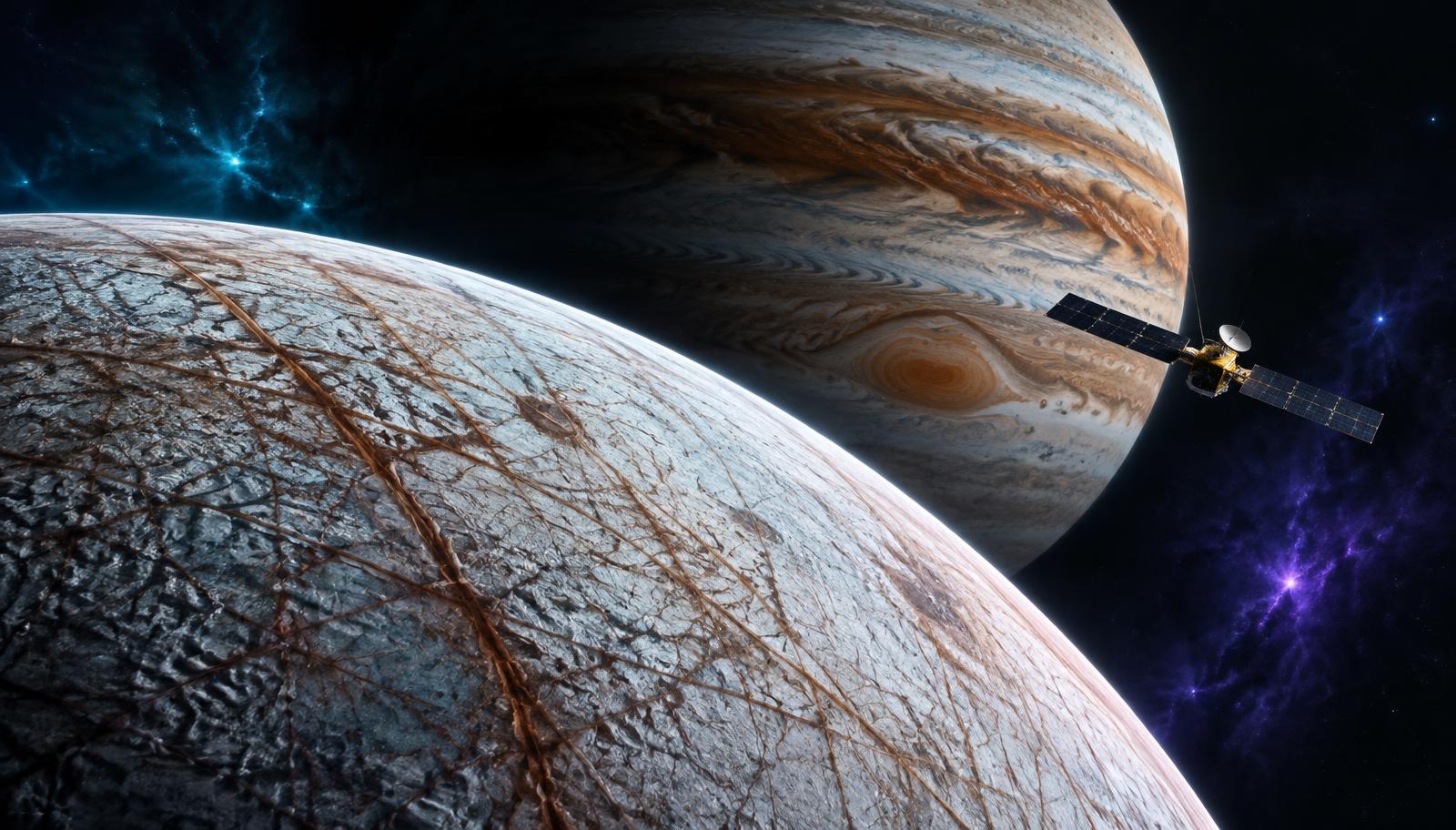
Artist's illustration · not a NASA image
Mission 01 · Shuttle Launch
Low Earth Orbit
Low Earth Orbit is the band of space up to about 2,000 km above Earth. It is where the International Space Station and most satellites fly.
- LEO altitude
- up to ~2,000 km
- ISS altitude
- ~400 km
- ISS speed
- ~28,000 km/h (7.7 km/s)
- One orbit
- ~90 minutes
- Sunrises per day (ISS)
- ~16
- Earth escape velocity
- 11.2 km/s
NASA context
The ISS has been continuously crewed since November 2000. Space Shuttles flew 135 missions between 1981 and 2011, carrying satellites, telescopes and station parts into LEO.
What it means in ASTRA
A day/night cycle every ~45 minutes means solar arrays need batteries to bridge the shadow half of each orbit.
Mission 02 · Lunar South Pole
The Moon
The Moon's south pole has craters whose floors have not seen sunlight for billions of years. NASA's Artemis program is targeting this region.
- Distance from Earth
- ~384,400 km
- Surface gravity
- 1.62 m/s² (~1/6 of Earth)
- Lunar day (sunrise to sunrise)
- ~29.5 Earth days
- Equator temperature
- ~−173 °C to 127 °C
- Shadowed crater floors
- below −230 °C
- Radio delay one way
- ~1.3 seconds
NASA context
NASA's Lunar Reconnaissance Orbiter has mapped the Moon since 2009 and measured some of the coldest temperatures in the solar system inside permanently shadowed craters, where water ice may be trapped.
What it means in ASTRA
Near the pole the Sun skims the horizon, so power and lighting change sharply with every crater rim and ridge.
Mission 03 · Mars Water Scout
Mars
Mars is a cold desert world with a thin carbon-dioxide atmosphere. Radar from orbit has found large amounts of water ice under its surface.
- Average distance from Sun
- ~228 million km (1.52 AU)
- Surface gravity
- 3.71 m/s² (~38% of Earth)
- Length of day (sol)
- 24 h 37 min
- Length of year
- 687 Earth days
- Atmosphere
- ~95% CO₂, under 1% of Earth's pressure
- Radio delay one way
- ~3 to 22 minutes
NASA context
The Perseverance rover landed in Jezero Crater on 18 February 2021. Mars Reconnaissance Orbiter's SHARAD radar has mapped buried ice sheets, a key resource for future human explorers.
What it means in ASTRA
With up to 22 minutes of radio delay, a Mars craft cannot be flown live from Earth. It needs autonomy and a strong comms link.
Mission 04 · Europa Ice Listener
Europa, moon of Jupiter
Europa hides a global saltwater ocean under an ice shell. It is one of the most promising places to look for conditions suitable for life.
- Diameter
- ~3,100 km (slightly smaller than our Moon)
- Orbit around Jupiter
- ~3.5 Earth days
- Estimated ice shell
- ~15 to 25 km thick
- Estimated ocean depth
- ~60 to 150 km
- Surface temperature
- ~−160 °C at equator
- Sunlight vs. Earth
- ~1/25 (about 4%)
NASA context
NASA's Europa Clipper launched on 14 October 2024 and is planned to reach Jupiter in 2030, making dozens of close flybys of Europa while dodging Jupiter's intense radiation belts.
What it means in ASTRA
Weak sunlight at Jupiter forces huge solar arrays or a nuclear power source, and electronics need heavy radiation shielding.
Spacecraft engineering numbers
- Deep Space Network
- 3 antenna sites: Goldstone (USA), Madrid (Spain), Canberra (Australia)
- Largest DSN dishes
- 70 m across
- Perseverance power
- MMRTG nuclear generator, ~110 W at launch
- Europa Clipper solar arrays
- ~30 m wingspan, NASA's largest planetary spacecraft
- Light time Earth→Sun
- ~8 min 20 s
- 1 Astronomical Unit (AU)
- ~149.6 million km
Figures are rounded from public NASA fact sheets and mission pages (science.nasa.gov, nssdc.gsfc.nasa.gov). ASTRA is an independent project and is not endorsed by NASA.